In a Review of Day Care Centers in the Us the Term ____ Describes the Average Center
Equally the percentage of women in the workforce has grown over fourth dimension — in 1974 information technology was but 47%, and by 2007 was nearly 71% — the need for affordable childcare options has become a focus of increasing media and public attention, with many new avenues for stories, trend analysis and investigations.
In his 2015 State of the Wedlock Address, President Obama put the result front end and center, proverb that childcare is a "must have" for working parents: "It'south time we stop treating childcare as a side upshot, or a women's issue, and treat information technology like the national economic priority that it is for all of us." He proposed a new almanac tax cut of upwards to $3,000 per kid.
Making daycare arrangements is now 1 of the primary economic and logistical concerns for working parents, with profound career implications, especially for women. According to the Bureau of Labor Statistics, 28% of mothers with immature children worked in 1975, more than doubling to 60% by 2013. Over the same menstruum, the number of daycare industry employees increased by nearly 250%. The BLS notes that investment in childcare by non-profit and authorities agencies, as well as new tax credits, also helped to fuel the industry's growth.
The grouping Kid Care Aware notes that near eleven million children nether age 5 spend an average of 35 hours a calendar week in child care. For infants in center-based intendance, the boilerplate annual cost ranges from $five,496 in Mississippi to $xvi,549 in Massachusetts; for four-twelvemonth-olds, care in a center ranges from $4,515 in Tennessee to $12,320 in Massachusetts, according to Child Intendance Enlightened. The quality of intendance and degree of regulation of facilities has been found to vary widely. Childcare workers (excluding preschool teachers) continue to be paid some of the everyman wages of whatever professional field — just $21,490 on average.
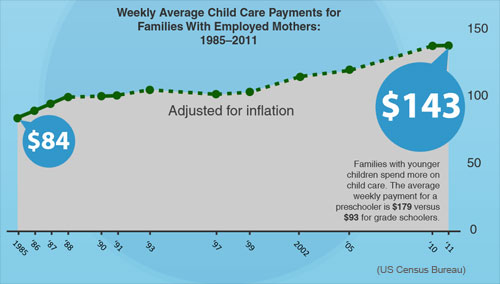
According to Census Bureau data, a third of young children — or 6.7 1000000 — receive care from a nonrelative on a regular basis, including 4.eight million children who attend an organized preschool or daycare facility. The remaining children are involved in other kinds of arrangements, such as daycare programs based in a provider's domicile. To see broad and shifting patterns of childcare across American society, encounter the Census Bureau's 2013 report "Who's Minding the Kids?" It notes that "families with children under five paid, on average, $179 per calendar week, or over $9,300 a year for child care." Further, "the average toll of childcare for families with an employed female parent increased between 2005 and 2010, from $124 to $142. While the cost of child care increased over time, the percent of family monthly income spent on child care has stayed abiding between 1997 and 2011, at around seven%."
Affording childcare can be a claiming for parents, particularly those with low incomes. A 2014 Pew Enquiry Centre report establish that families earning less than $18,000 annually spend about twoscore% of their income on childcare (compared to 7.2% of income for all families). The report notes that the number of stay-at-home mothers has increased over the by 15 years, a trend that may be explained by prohibitive childcare costs. At the same time, there are a number of regime programs that offer free admission to daycare and preschool for young children. The federally funded Head Beginning program serves more than one meg children from nativity to historic period v. All but x states accept state-funded preschool programs, which ordinarily serve children starting at age 4, only funding and participation rates vary widely.
A growing trunk of bookish research has constitute evidence that early childhood pedagogy programs provide wide-ranging benefits that may persist for the rest of a child's life. The Abecedarian Project, i of the most important studies on the long-term effects of preschool, randomly assigned students to an early childhood didactics program or a control grouping. The report has tracked its participants since the 1970s and has found that attention preschool had long-lasting benefits on academic performance, career development and health outcomes. Meaning research continues on early childhood didactics and support programs for children of lower socioeconomic status.
For state-by-state data, including locations of facilities and rules, see Childcare.gov. Child Care Aware too provides state-level analysis and ranks each country according to the degree of oversight and regulation, among other metrics.
Below is a choice of relevant studies as well as other information sources on daycare and early childhood education in the Usa.
_______
"The State of Preschool 2013"
Barnett, W.Southward., Carolan, M.E., Squires, J.H., Clarke Brown, K. National Institute for Early Teaching Research.
Findings: "After the 2011-2012 downturn in spending and quality, many state pre K plan budgets leveled off and even regained some ground. This offers hope that equally state budgets sally from the recession, policymakers will prioritize early learning programs. However, this was too the beginning twelvemonth since nosotros began reporting (2001-2002), that states failed to increase the number of children they serve in pre-G. The loss of 9,160 children from enrollment at age 4 and 42 children at age 3 are pocket-size changes, but this is the first decrease we have observed. At the same time, this represents a reversal—or at least a interruption—of the tendency toward spreading too little funding over ever more children, which led to expanded admission while jeopardizing programme quality. What remains to be seen is whether the modest enrollment subtract of 2012-2013, coupled with a small increment in spending, represents a turning signal after which both access and quality volition exist increased, or merely a new stasis in which neither advances significantly."
"Adult Outcomes every bit a Function of an Early Childhood Educational Program: An Abecedarian Project Follow-Upward"
Campbell, F. A., Pungello, E. P., Burchinal, M., Kainz, Grand., Pan, Y., Wasik, B. H., Ramey, C. T. Developmental Psychology, 2012. Vol. 48, Consequence four. doi: ten.1037/a0026644.
Findings: "Consequent with findings from the other studies being compared here, the Abecedarian Project's treated group significantly excelled over the control grouping in educational attainment at age xxx. The standardized effect size was moderately large. Unexpectedly, even so, the Abecedarian early on treatment was non associated with a higher rate of high school graduation, but rather with going beyond high school. Prior assay examining the predictors of young adult educational activity suggested that family unit factors were relatively more influential insofar as completing high schoolhouse was concerned, whereas early childhood intervention was strongly related to going on to higher (Pungello et al., 2010). At historic period 30, the treated Abecedarian participants were 4.vi times more likely than the control participants to have earned college degrees."
"Parental Stress and Daycare Attendance"
Bigras, Northward., Lemay, L., Brunson, Fifty. Procedia – Social and Behavioral Sciences, 2012. Vol. 55. doi: doi:10.1016/j.sbspro.2012.09.578.
Findings: "Our results betoken that parental satisfaction with daycare is a significant predictor of parental stress and that low quality of care moderates the relation betwixt depression family income and high parental stress. The results underline the importance of daycare quality and of parental satisfaction in regulated daycare and the importance of interventions designed to heighten quality in daycare settings where levels of quality are low. These results are particularly important in a context where a regulated nonprofit childcare services network is largely funded by the government in order to insure equal opportunities for all."
"Early on babyhood intervention and life-cycle skill development: Evidence from Head Start"
Deming, David. American Economical Journal: Applied Economic science, 2009. Vol. 1, Issue, three. doi: x.1257/app.i.three.111.
Findings: "This paper provides evidence of the long-term benefits of Head Start for a recent birth accomplice of children. While my results rely on non-experimental comparisons betwixt siblings who differ in their participation in the program, I find petty evidence of systematic within-family bias in preschool assignment, and the results are robust to sensitivity checks and alternative specifications. I estimate that the long-term impact of Head Get-go is about 0.23 standard deviations on a summary index of young adult outcomes, with larger impacts for African Americans and relatively disadvantaged children."
"How Can Parents Become Involved in Preschool? Barriers and Engagement in Teaching past Indigenous Minority Parents of Children Attention Head Outset"
Mendez, Julia. Cultural Diversity and Ethnic Minority Psychology, 2010. Vol. 16, Issue 1. doi: 0.1037/a0016258.
Findings: "An intervention was developed to promote parent involvement with ethnic minority families of children attending Head Beginning preschool programs. Two hundred eighty-8 predominantly African American families from a small-scale southern city were included in this study. Parent satisfaction with the plan was high, withal engagement was less than optimal. Some effects were found for the program, despite depression levels of participation. Indigenous minority parents who received the intervention increased the frequency of reading to their child as compared with parents in a comparison group who did not receive the plan. The quality of the parent–teacher relationship was significantly correlated with parental participation in the intervention. Program participation and the parent–teacher relationship were correlated with higher levels of children's school readiness abilities. Children in the intervention condition showed stronger end-of-yr receptive vocabulary and parent-rated social competence as compared with children who did not receive treatment."
"Unintended Consequences of Child Intendance Regulations"
Blau, David K. Periodical of Labour Economics, June 2007, Vol. 14, No. 3. doi: x.1016/j.labeco.2006.01.003.
Findings: "The effects of regulations governing staff-child ratio, grouping size, and staff qualifications in kid intendance centers are estimated, using data on a sample of centers. The information contain measures of staff characteristics and wages, cost of the service, and the developmental quality of the child care provided. Regulations vary across states, but may exist endogenous to these outcomes. Estimates with state fixed effects are viable considering regulations vary within states past age group of children and chore title of staff. Estimates with state fixed effects show that tougher regulations have some impact on input use, just take piffling or no impact on price and quality. The most striking finding is that tougher regulations reduce staff wages, suggesting that the incidence of child care regulations is on employees of daycare centers."
Keywords: parenting, children, women and piece of work, research roundup
Source: https://journalistsresource.org/education/early-childhood-care-education-united-states-research-roundup/
0 Response to "In a Review of Day Care Centers in the Us the Term ____ Describes the Average Center"
Post a Comment